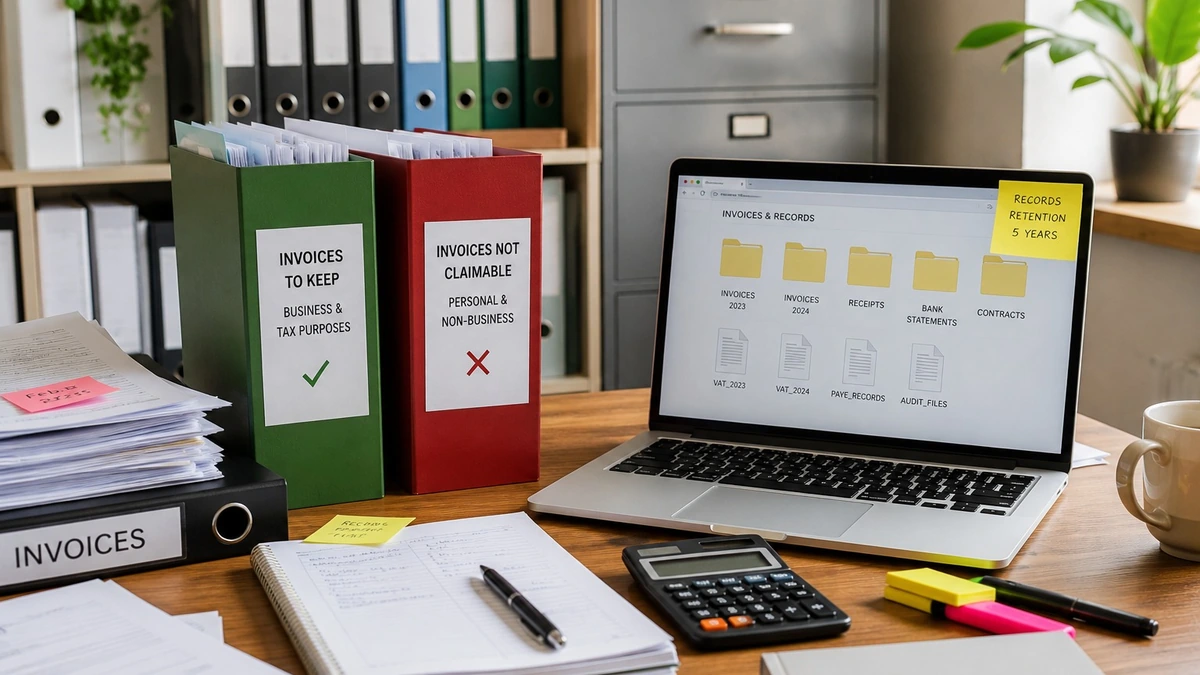
You generally have to keep invoices and records for five years. For most small businesses the period runs from the date the relevant return was submitted, and it runs longer where an audit, objection or dispute is underway.
How long to keep invoices and records
- Invoices you issued and invoices you received
- Quotations, where they support what was agreed
- Credit notes and debit notes
- Bank statements
- Receipts and proof of payment
- Contracts and purchase orders
- Your accounting records and VAT returns
Records you received matter as much as records you issued. An input tax claim without the supplier's tax invoice behind it is a claim you cannot support.
What form they can take
Electronic records are acceptable. They need to be readable, retrievable and unaltered, which in practice means a system you can search, not a folder of files named invoice final v2.pdf.
Three places small businesses lose records:
- A phone. Invoices sent by WhatsApp and stored nowhere else disappear with the handset.
- A personal email account. Especially one belonging to someone who has left.
- A laptop with no backup. The failure is not dramatic, it is a hard drive.
A practical setup
| Record | Where it should live |
|---|---|
| Invoices and quotes issued | Your invoicing system, which keeps them by default |
| Supplier invoices | One folder per financial year, or your accounting software |
| Bank statements | Downloaded monthly, not left in online banking |
| Contracts and POs | Filed with the client, not in an inbox |
The test is simple: if SARS asked for every document supporting one invoice from three years ago, how long would it take you to produce them? If the answer is more than a few minutes, the system is the problem.
Common questions
Is five years always the period?
Five years is the general rule, and it can be longer where a return has not been submitted, or where an audit, objection or appeal is in progress. Confirm your position for anything unusual.
Do I need paper copies?
No. Electronic records are acceptable provided they remain readable and retrievable.
What about records from a business that closed?
The retention obligation does not disappear when trading stops.
Quote to Invoice keeps every document you issue in the account, so the record is not sitting on a phone.
Start invoicing- Tax Administration Act 28 of 2011
- Value-Added Tax Act 89 of 1991
- SARS, primary legislation
Disclaimer: This content is for general information only and does not constitute legal, tax, accounting or financial advice. Always confirm important requirements with SARS, the relevant authority or a qualified professional.